
Today’s Morning Buzz is brought to you by Emily Colon. Emily is a former deputy city manager turned consultant with the Southern Group. Connect with Emily on LinkedIn.
- What I’m reading: The latest PM Magazine with my friend, Mario Diaz, on the cover!
- What I’m watching: My daughter playing indoor soccer called futsal—SO fun!
- What I’m eating: Entirely too many Christmas cookies.
If you work in local government, there’s a good chance you’ve said one (or more) of the following this year:
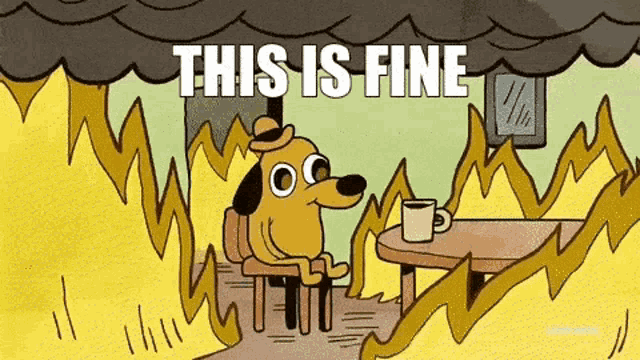
- “It’s fine. I’m fine. Everything is fine.”
- “I need to get another cup of coffee.”
- “I’ll rest after budget season / hurricane season / election season / [insert season here].”
Burnout has become the quiet companion of public service, sitting in the passenger seat during long commission meetings, whispering during back-to-back Zooms, and showing up uninvited on Sunday nights. And yet, many of us treat burnout like a personal failure instead of what it really is: a signal.
Burnout Isn’t Laziness. It’s Data
Burnout is not about a lack of commitment, grit, or resilience. I see this often in my work with local governments where the most dedicated leaders are usually the first to feel it. In fact, in local government, it often shows up because you care deeply. It’s the cumulative effect of high expectations, constant urgency, limited resources, public scrutiny, and the very real pressure of knowing that your decisions impact people’s lives.
Burnout is your system saying: Something here needs attention.
It might look like:
- Decision fatigue that makes even small choices feel heavy.
- Cynicism creeping into work you once loved.
- Exhaustion that sleep doesn’t fix.
- Feeling behind no matter how much you do.
None of that means you’re bad at your job. It means you’ve been doing it, often heroically, for a long time.
The Problem with Treating Burnout as a Destination
Too often, burnout gets framed as an endpoint. If I burn out, it means I could not hack it. So, we push through, power up, and pride ourselves on endurance. We normalize being underwater. We quietly compete over who is busiest and most exhausted.
But burnout is not a dead end. It is a crossroads.
When we reframe burnout as feedback instead of failure, it becomes an opportunity to reset, not quit, not give up, but recalibrate. To ask better questions, like:
- What am I carrying that no longer needs to be mine?
- Where have urgency and importance become confused?
- What boundaries eroded slowly while I wasn’t looking?
- What version of “normal” am I trying to return to, and should I?
A Reset Does Not Mean Retreat
A reset does not require a dramatic resignation letter or a sabbatical in the mountains, though no judgment if that is your plan. Often, it’s smaller and more practical:
- Clarifying priorities instead of reacting to everything.
- Rebuilding margin into your calendar.
- Having honest conversations about capacity.
- Letting “good enough” be good enough sometimes.
- Remembering that rest is a leadership strategy, not a reward.
Local government needs steady, thoughtful leaders, not just present ones. And steadiness requires sustainability.
As We Head Toward 2026…
As another year winds down and we collectively eye the fresh calendar pages of 2026, my hope is simple. That you find space to recharge before the next sprint begins. Whether that means taking real vacation time, unplugging for a few days, or just closing your laptop a little earlier than usual. Consider it an investment, not an indulgence.
Burnout isn’t a verdict. It’s information. And if you listen to it now, you just might start the new year with more clarity, energy, and intention than you expected.
Sustainable leadership is not about how much you can carry. It is about how long you can lead well.
If your job is to serve the public, your energy is a public asset. Protect it accordingly.
Here’s to rest, reset, and to a better 2026!